Patient studies and blood tests
Tesamorelin research: what changed and what didn't.
The trials measured belly fat, blood sugar, side effects, and IGF-1, a liver-made growth protein. They also show where proof ends.
What tesamorelin changed in patient trials
The first goal was to treat an odd belly-fat shift. Scientists focused on patients taking HIV antiviral drugs. Tesamorelin acts on your growth gland. In response, hormone leaves the gland in short waves. Your liver makes IGF-1, a growth protein. Doctors used the IGF-1 blood level to track the response. Together, the two hormones help your body use fat beside stomach organs. Across six months, daily treatment cut this fat about 15%. At one year, the drop still stood near 18% [1][2]. A scan study reported a liver-fat drop [6]. Tesamorelin left blood within minutes. The hormone response continued all day [10].
Only adults with HIV supplied those figures. The results can't show that other people lose weight.
Daily shots reduced organ fat. Neither fat beneath your skin nor overall weight changed.
How tesamorelin starts growth hormone and IGF-1
Scientists made tesamorelin to act on your growth gland. The medicine prompts gland cells to send stored hormone through the body [4]. That hormone reaches your liver and raises IGF-1. This liver-made growth protein helps your body use fat held near the organs [1]. Doctors followed IGF-1 blood tests through the process. Together, growth hormone and IGF-1 produced the response.
A small cap protects tesamorelin from blood enzymes. Those proteins would otherwise break it apart at once. In a trial, 13 healthy men each got 2 mg each day beneath the skin for two weeks. Overnight growth hormone rose. IGF-1 rose by 181 micrograms per liter [4]. Fasting blood sugar stayed steady. Their bodies also kept handling insulin normally. Tests found hormone waves instead of a nonstop flood [10].
Your own gland supplies each hormone burst. The shot doesn't contain growth hormone.

What tesamorelin changed in the biggest studies
The large trials included only patients with HIV. One study followed 412 adults taking daily shots of 2 mg. The shots went under the skin. Organ fat in the belly fell. A harmful blood fat dropped by 50 milligrams per deciliter. In the placebo patients, that blood fat rose by 9 milligrams per deciliter. A placebo is an inactive shot used for comparison. IGF-1 also went up [1]. This is a liver-made growth protein. Over one year, researchers compared 273 treated patients with 137 placebo patients. Treatment held organ fat 18% below its starting point. Blood sugar stayed steady [2].
Researchers then joined two Phase 3 trials. The count was 543 treated patients and 263 placebo patients. Doctors marked each organ-fat patch on flat belly scans. More treated patients crossed the trial cutoff of 140 square centimeters. That number marks space traced on the scan image; it isn't weight. The difference held with 95% certainty [13]. A drop of at least 8% also came with better blood-fat tests. Blood tests tied to heart health improved [11]. During 26 weeks, CT scans showed denser-looking fat [12]. The study treated that scan change as a sign of fat quality. It didn't mean greater body weight. The fat drop was similar with or without neck fat [14]. A five-trial review in 2026 reported an organ-fat drop with 95% certainty [3].
The shots changed fat beside organs. Fat just beneath the skin stayed put.
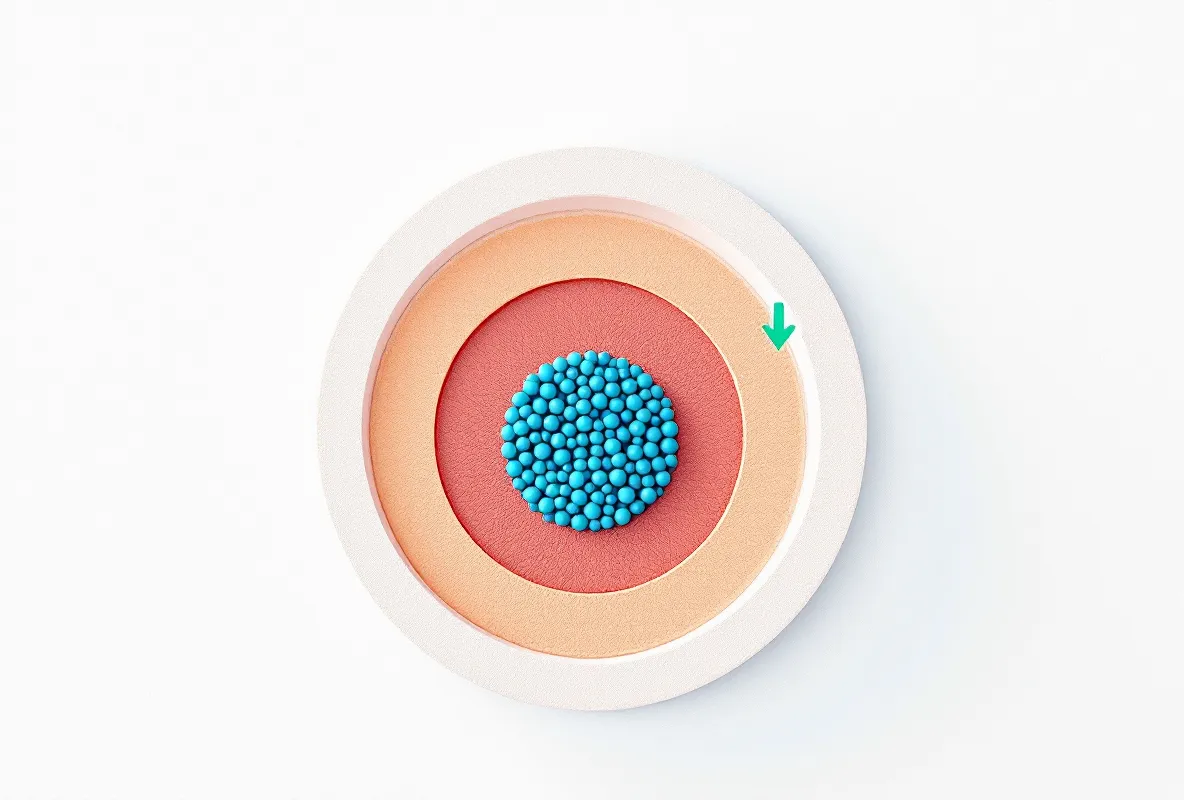
How tesamorelin changed liver fat and IGF-1
These liver studies were small and limited to adults with HIV. In one trial, doctors marked organ fat on flat scan images. The marked area shrank by 42 square centimeters. Liver fat dropped too [6]. A 2026 review joined several trials and reported the same trend [3].
Another study followed 61 adults with HIV and fatty liver disease. Low growth hormone went with more liver fat. It also went with worse blood sugar. The paper gave four blood proteins the labels 1, 3, 2, and 6 [9]. Those labels are names, not amounts or grades. The plain finding is that growth medicine changed how some blood proteins carry or slow hormone messages. The clotting test improved alongside the organ-fat drop [11]. Approval doesn't cover this liver use beyond HIV care.
The liver findings may guide later study. This use isn't approved.

How long tesamorelin stays in the blood
Tesamorelin doesn't stay in your blood for long. The amount fell by half in about thirty minutes. One study formula reported 1,060 liters per hour [10]. Nobody has that much body fluid. The number comes from a formula and means the medicine leaves blood fast.
Trials gave 1 injection each day. The drug itself was gone within minutes. Yet IGF-1, the liver-made growth protein, stayed raised longer [10]. Your hormone response continued after the medicine had left.
In the trials, each shot went just beneath belly skin.
What medical reviews conclude about tesamorelin
Two Phase 3 studies form the base of the proof [1][2]. Both enrolled people receiving HIV care. Smaller studies checked liver fat [6], blood sugar [7], different amounts [8], and healthy men [4]. A separate test timed the drug in blood [10]. Reviewers joined the results in 2026 [3]. The papers also tracked IGF-1, a liver-made growth protein. Organ fat fell in the HIV groups. That cannot prove weight loss for everyone. These are study findings, not customer reviews.
How does tesamorelin work?
Tesamorelin prompts your growth gland. The released hormone makes your liver raise IGF-1 [4]. Healthy men took 2 mg each day. Overnight growth hormone went up. IGF-1 rose by 181 micrograms per liter [4].
How does tesamorelin start growth hormone release?
The medicine reaches cells in your growth gland. Those cells send stored hormone into blood. A small cap keeps blood enzymes from breaking down the drug. Tests recorded short hormone waves and an IGF-1 rise [4][10].
Is tesamorelin growth hormone?
It's a trigger, not the hormone itself. Your own gland supplies the growth hormone. Your liver then makes IGF-1 [4].
Does tesamorelin raise IGF-1?
Yes. IGF-1 is a growth protein made by your liver. Its blood level rose in the main trial [1]. In healthy men, 2 mg each day raised IGF-1 by 181 micrograms per liter [4]. An early study found a 48% rise at 1 mg. The rise was 65% at 2 mg [8].
Will tesamorelin help me lose belly fat?
Adults with HIV took 2 mg each day. Their organ fat fell over 26 weeks [1]. The proof covers the HIV-related fat shift only. Large trials have not shown general weight loss.
Does tesamorelin reduce deep belly fat?
The trial found less fat beside organs. It did not find a matching drop just under the skin. Overall body weight stayed steady. Five trials were joined in a 2026 review, which reported the same result [3]. Growth hormone and IGF-1 rose with the change.
When did tesamorelin studies find fat loss?
The first clear measure came at 26 weeks. Daily shots held the drop near 18% through 52 weeks [1][2]. Those are trial times. Your result may not match them.
What happened after patients stopped tesamorelin?
Stopping the shots let organ fat come back [2]. That change did not last after treatment.
Was tesamorelin tested for fat loss without HIV?
Adults with HIV made up the main trial groups [1]. Researchers also tested a small group of healthy men; IGF-1 rose as expected [4]. A large public fat-loss trial has not been done. Without HIV, the use lacks approval.
Did tesamorelin studies include fatty liver disease?
One HIV study reported a liver-fat drop [6]. Treatment for fatty liver alone is still being tested. Approval remains limited to the HIV-related belly-fat problem.
What did tesamorelin change in a fatty liver?
Liver fat dropped along with organ fat [6]. Another study linked low IGF-1 with more liver fat. Poorer blood sugar also went with low levels [9]. All of these patients were in HIV care.
How sure are the tesamorelin liver-fat findings?
One patient study recorded a liver-fat drop [6]. A 2026 review saw the result across several trials [3]. Approval does not cover liver-fat treatment by itself.
How fast does tesamorelin leave your blood?
Half the drug was gone in about thirty minutes. A study formula reported 1,060 liters per hour [10]. That number is not body fluid. It is simply a formula showing quick removal.
How long do tesamorelin's effects last?
The drug itself leaves within minutes. The same study reported 1,060 liters per hour [10]. Your hormone response lasts longer. One daily shot kept IGF-1 raised through the day.